

Have you ever made a snap decision and later regretted it? Most of us have. Sometimes the cost is small, but for leaders, a rushed or poorly thought-out course of action can have serious consequences.
Executives and boards today face relentless pressure: Cyber threats, pandemics, environmental crises, disrupted supply chains, trade wars, policy shifts, scandals and corruption are all testing decision-making like never before.
With the explosion in AI-related initiatives, failure rates for pilot projects hover around 95 percent, with analysts attributing much of this to poor decisions – a symptom of uncritical thinking.
As a long-time Master Facilitator with Janellis – a firm specialising in critical thinking systems – I’ve seen these dynamics play out in training, real-time crises and boardroom simulations.
The lesson is clear: If your people aren’t thinking critically as individuals or teams, it’s costing you time, money and possibly your career.
Speed Versus Quality
Agility and adaptability are corporate buzzwords for good reason – organisations must respond quickly to disruption.
Yet the faster decisions are pushed to the frontlines, the greater the risk of poor calls that subsequently require executive intervention – exactly what they are trying to avoid in the first place.
Critical thinking is the antidote to this speed trap. When embedded in teams, it balances responsiveness with rigour and ensures decisions are made quickly and intelligently.
Before exploring team-based applications in more detail, let’s briefly unpack what critical thinking actually involves.
How Critical Thinking Works
Critical thinking begins with awareness – knowing when a structured approach is needed in a ‘situation’ rather than relying on a knee-jerk response.
The process starts with separating facts from assumptions and identifying the main issue that you are managing.
From there, you can model potential outcomes – best case, worst case and most likely – and assess their impacts across key areas before deciding on a course of action.
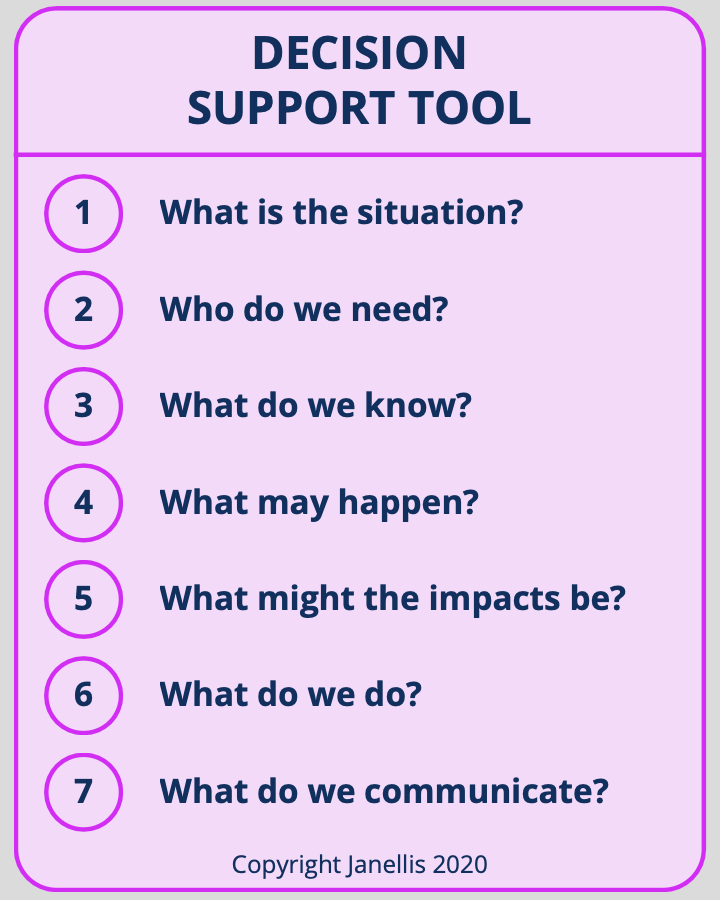
These steps come from the Janellis 7-step decision support tool, which helps leaders move from reactive decision-making to more informed, objective processes.
The steps are pretty straight forward, however many nuances and learnings accumulate with ongoing exposure to the process.
When You Need It
Critical thinking applies to almost every decision, from planning holidays to setting next year’s budget.
Ask these two questions of your ‘situation’ to help determining how much structure is required:
- How urgent is the decision?
- How important is it?
When the stakes and level of importance is high – such as during crises or major strategic moves – a disciplined approach to decision-making is essential.
You may have to act fast, but structured thinking ensures you’re acting wisely, even if you have incomplete or conflicting information.
Team-Based Critical Thinking
Team-based critical thinking brings together a group of people who are best equipped to tackle the situation at hand. Instead of one leader carrying the load, it taps into the diversity of perspectives, expertise and experiences.
Airlines, for example, use structured team-based processes when responding to crises like accidents, weather events or industrial action. Likewise, emergency services and the military draw on well-rehearsed processes that enable calm, coordinated and effective decisions under pressure.
Organisations that excel at this find ways to steer away from the worst-case and toward the best possible outcome, despite prevailing uncertainties and constraints.
Why It Matters
Most executives reach senior levels because they already think critically and know how to engage others in the process.
The real gap lies with emerging leaders who may respond too quickly or fail to assemble the right people when facing complex challenges.
However, when teams are trained and practised in using a shared critical thinking framework, they can make high-quality, objective decisions seamlessly and under pressure.
It’s not about slowing things down; it’s about getting it right when it counts.
Suggested Actions
The ever-changing business environment requires constant decision-making – there’s nowhere to hide.
Take stock of your organisation’s critical thinking capability – both at the individual and team level – to identify the gaps, build the skills and practise them so that you are ready for the next crisis or strategic move.
It’s one of the smartest investments you can make – saving time, money, and possibly your career.
= = =
Phil Preston empowers change and transformation. He’s a keynote speaker, facilitator and corporate event host who can be contacted via phil@philpreston.com.au
